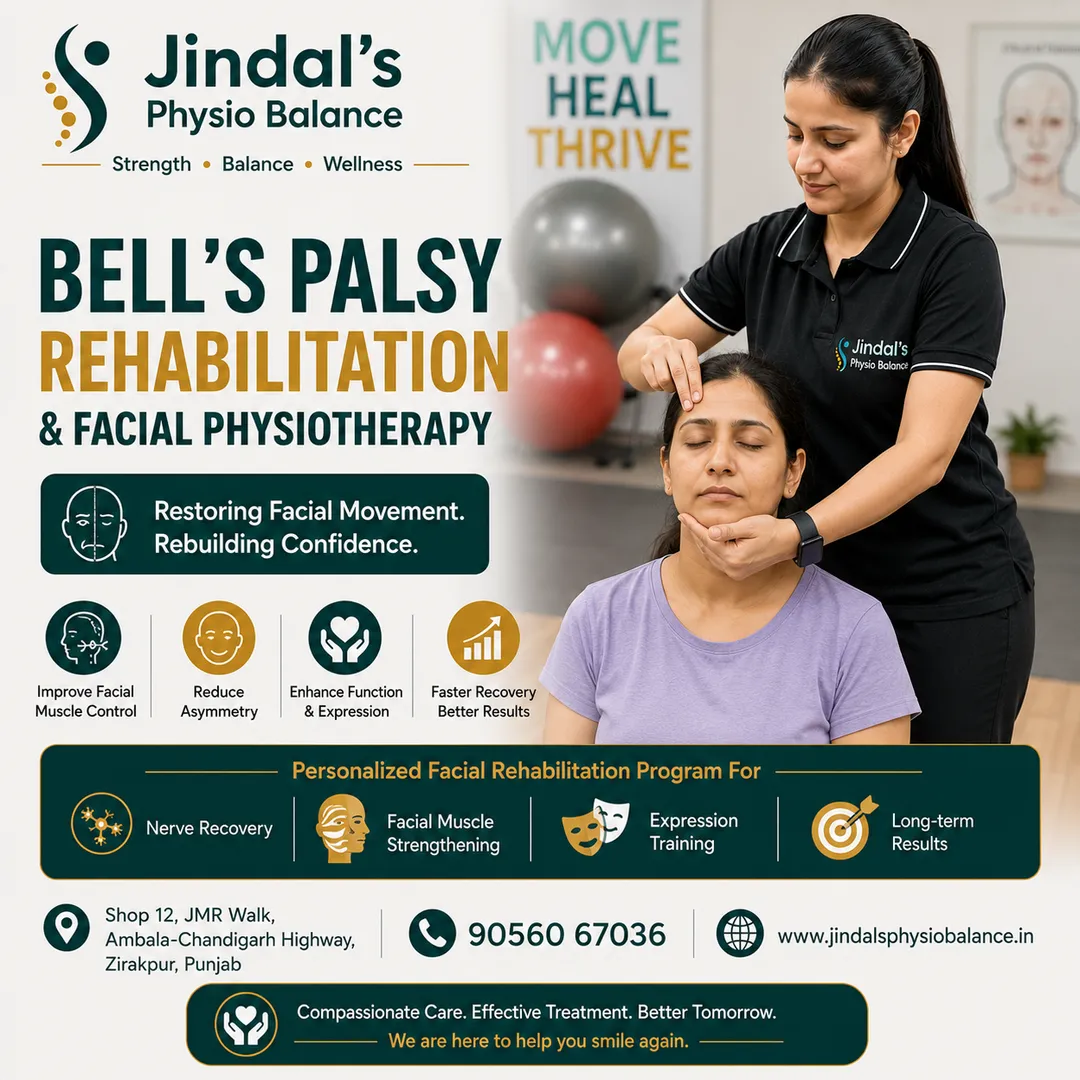
Bell’s palsy is a condition that causes sudden weakness or paralysis of one side of the face. It can affect facial expression, smiling, eye closure, eating, drinking and speaking, and the sudden change in facial appearance can understandably be distressing.
Although many people with Bell’s palsy recover well, recovery can vary from person to person. Some people recover quickly, while others may experience persistent facial weakness, stiffness, involuntary facial movements or other complications.
Bell’s Palsy rehabilitation may be considered as part of recovery for people who have ongoing facial movement problems.
If you are searching for Bell’s Palsy physiotherapy in Zirakpur, it is important to understand that rehabilitation should be individualized. Facial exercises are not simply a matter of repeatedly moving the face as much as possible. The type, timing and intensity of facial rehabilitation should depend on the stage of recovery and the person's symptoms.
What Is Bell’s Palsy?
Bell’s palsy is an acute peripheral facial nerve disorder that causes weakness or paralysis of the muscles on one side of the face.
The facial nerve controls many muscles responsible for facial expression and also has roles related to eye closure and other functions.
A person with Bell’s palsy may suddenly notice:
- Drooping of one side of the face
- Difficulty smiling
- Difficulty closing one eye
- Reduced facial expression
- Difficulty drinking without liquid escaping from the mouth
- Difficulty eating
- Changes in speech
- Altered taste in some cases
- Increased sensitivity to sound in some cases
Symptoms can vary considerably between individuals.
Bell’s Palsy Is Not the Same as a Stroke
This distinction is extremely important.
Sudden facial weakness can occur with a stroke, and Bell’s palsy is only one possible cause of facial weakness.
If facial weakness develops suddenly—particularly when accompanied by arm or leg weakness, speech difficulty, confusion, severe dizziness, vision problems or other neurological symptoms—urgent medical assessment is required.
Do not assume sudden facial weakness is Bell’s palsy without appropriate medical evaluation.
Once Bell’s palsy has been diagnosed, rehabilitation can be considered according to the individual's presentation.
What Happens During Bell’s Palsy?
Bell’s palsy affects the facial nerve, which temporarily affects the muscles supplied by that nerve.
The severity can range from relatively mild weakness to almost complete paralysis on one side of the face.
During the early stage, a person may have difficulty:
- Closing the affected eye
- Smiling
- Raising the eyebrow
- Wrinkling the forehead
- Moving the cheek
- Controlling the lips
- Drinking
- Eating
The course of recovery varies.
Some people regain facial movement relatively quickly, while others may require longer-term rehabilitation.
Why Is Bell’s Palsy Rehabilitation Important?
Most people with Bell's palsy recover significantly, but some can experience persistent facial weakness or abnormal facial movement.
Rehabilitation may be particularly relevant when a person has:
- Persistent facial weakness
- Difficulty with facial movements
- Difficulty closing the eye
- Problems with eating or drinking
- Reduced facial expression
- Facial tightness
- Unwanted associated facial movements
- Difficulty coordinating facial movements
The goal is not simply to make the face move more.
The goal is to encourage appropriate, controlled and functional facial movement while avoiding unnecessary overactivation.
When Should You See a Physiotherapist?
A neurological physiotherapy assessment may be considered when facial weakness persists or when the person has difficulty returning to normal facial function.
Assessment may be particularly useful when there is:
- Ongoing facial asymmetry
- Difficulty smiling
- Difficulty closing the eye
- Persistent weakness
- Facial tightness
- Unwanted facial movements
- Difficulty eating or drinking
- Difficulty controlling facial expressions
- Concerns about recovery
The timing and type of rehabilitation should depend on the individual's stage of recovery.
What Does a Bell’s Palsy Assessment Include?
A physiotherapist may assess different aspects of facial function.
Facial symmetry
The therapist may observe the face at rest and during different expressions.
Voluntary facial movement
Movement may be assessed during tasks such as:
- Raising the eyebrows
- Closing the eyes
- Smiling
- Showing the teeth
- Puckering the lips
- Inflating the cheeks
Eye closure
Adequate eye closure is particularly important because incomplete closure can leave the eye vulnerable to dryness and injury.
Eye protection should be discussed with the treating medical professional when eye closure is incomplete.
Oral motor function
The therapist may observe activities such as drinking, lip closure and managing food.
Facial coordination
During recovery, some people may develop difficulty performing one facial movement without unintentionally activating another.
This may require a different rehabilitation approach from simple strengthening.
Bell’s Palsy Facial Exercises
Facial exercises are often discussed online, but more exercise is not always better.
The appropriate exercises depend on the stage and pattern of recovery.
Depending on the individual's presentation, rehabilitation may include carefully selected activities involving:
- Facial awareness
- Gentle facial movement
- Symmetry
- Controlled smiling
- Lip movement
- Eye and facial coordination
- Functional facial activities
The emphasis should be on quality and control of movement, not repeatedly forcing large facial movements.
People should avoid aggressively exercising a weak or recovering facial muscle without professional guidance.
Facial Rehabilitation During Recovery
As facial movement begins to return, rehabilitation may progress from basic movement awareness toward more controlled functional activities.
The physiotherapist may focus on:
Awareness → Controlled movement → Symmetry → Coordination → Functional facial expression
The programme should be adjusted according to the individual's response.
Synkinesis After Bell’s Palsy
Some people develop a condition called facial synkinesis during recovery.
Synkinesis occurs when an intended facial movement is accompanied by an unwanted movement in another area.
For example, a person may notice unwanted eye narrowing when smiling.
This can happen because of abnormal reinnervation of the facial nerve during recovery.
Symptoms can include:
- Eye narrowing during smiling
- Unwanted facial contractions
- Facial tightness
- Difficulty isolating facial movements
- Reduced facial coordination
Synkinesis requires a different rehabilitation approach from simple facial strengthening.
Specialized facial neuromuscular retraining may be considered in appropriate cases.
Bell’s Palsy and Eye Protection
One of the important early concerns in Bell’s palsy is incomplete eye closure.
If the affected eye does not close properly, the surface of the eye can become dry and vulnerable to injury.
People with incomplete eye closure should follow the eye-care advice provided by their doctor or eye-care professional.
Physiotherapy does not replace appropriate medical or ophthalmic eye care.
Bell’s Palsy and Eating or Drinking
Facial weakness can make it difficult to control food and liquids.
A person may notice:
- Difficulty keeping liquids inside the mouth
- Food collecting between the cheek and teeth
- Difficulty controlling the lips
- Changes in chewing or eating efficiency
If swallowing itself is difficult, coughing occurs while eating or drinking, or there are concerns about aspiration, assessment by an appropriate healthcare professional such as a speech and language therapist may be required.
Can Physiotherapy Cure Bell’s Palsy?
Physiotherapy should not be presented as a guaranteed cure for Bell’s palsy.
Recovery depends on several factors, including the severity of the nerve involvement and the individual's recovery pattern.
The role of rehabilitation is to help optimize facial movement and function when appropriate.
Treatment may focus on:
- Facial movement
- Symmetry
- Coordination
- Functional facial activities
- Management of persistent weakness
- Management of abnormal movement patterns
A person should also continue appropriate medical follow-up.
How Long Does Bell’s Palsy Recovery Take?
Recovery varies considerably.
Some people experience substantial improvement within weeks, while others may have symptoms that persist for months.
The timeline depends on the severity and individual recovery pattern.
Because recovery is variable, rehabilitation should be monitored and progressed rather than following a rigid timeline.
Bell’s Palsy Rehabilitation in Zirakpur
If you or a family member is recovering from Bell’s palsy and continues to experience facial weakness, asymmetry or difficulty controlling facial movements, neurological physiotherapy may be considered as part of rehabilitation.
At Jindal’s Physio Balance, Zirakpur, neurological rehabilitation focuses on individualized assessment and functional goals.
Depending on the person's presentation, rehabilitation may include:
- Facial movement assessment
- Facial neuromuscular retraining
- Movement coordination
- Symmetry training
- Functional facial activities
- Patient education
- Home rehabilitation guidance
The rehabilitation programme is adapted according to the person's stage of recovery and individual needs.
When Should You Seek Medical Help?
Sudden facial weakness should be medically evaluated, particularly when the diagnosis has not yet been established.
Seek urgent medical attention if facial weakness occurs together with symptoms such as:
- Arm or leg weakness
- Difficulty speaking
- Confusion
- Sudden severe dizziness
- Vision changes
- Difficulty walking
- Severe headache
- Loss of coordination
These can be signs of a neurological emergency.
Similarly, worsening symptoms, significant eye problems or difficulty swallowing require appropriate medical attention.
Frequently Asked Questions
Can physiotherapy help Bell’s palsy?
Physiotherapy and specialized facial rehabilitation may help selected people with persistent facial weakness or abnormal facial movement. The appropriate approach depends on the stage and pattern of recovery.
What exercises are good for Bell’s palsy?
There is no single exercise programme suitable for everyone. Facial rehabilitation should be individualized, with emphasis on controlled and appropriate movement rather than aggressive repetitive exercise.
Can Bell’s palsy be completely cured?
Many people recover significantly, but recovery varies. Some people may have persistent weakness or abnormal facial movement.
Can Bell’s palsy cause permanent facial weakness?
Some people can have residual facial weakness or other long-term effects. Persistent symptoms should be assessed appropriately.
What is facial synkinesis?
Facial synkinesis is an unwanted facial movement that occurs together with an intended movement, such as eye narrowing when smiling. Specialized facial rehabilitation may be considered for people experiencing synkinesis.
Should I massage my face after Bell’s palsy?
Massage is not automatically appropriate for every stage or presentation of Bell’s palsy. Rehabilitation should be individualized rather than relying on a generic facial massage routine.
Can Bell’s palsy happen again?
Recurrence can occur in some people. If new facial weakness develops, it should be medically evaluated rather than automatically assumed to be another episode of Bell's palsy.
Where can I get Bell’s Palsy rehabilitation in Zirakpur?
Jindal’s Physio Balance provides neurological physiotherapy and rehabilitation in Zirakpur, including assessment and rehabilitation for facial weakness and Bell’s palsy.
Final Takeaway
Bell’s palsy can affect much more than facial appearance. It can influence eye closure, eating, drinking, speaking, facial expression and confidence.
While many people recover well, some experience persistent weakness or abnormal facial movements that may benefit from specialized rehabilitation.
The most important principle is:
Don't just exercise the face. Assess the movement and rehabilitate it appropriately.
If you or someone in your family is recovering from Bell’s palsy, a neurological physiotherapy assessment can help determine whether facial rehabilitation is appropriate.
Jindal’s Physio Balance
Family Physiotherapy & Rehabilitation Centre, Zirakpur
Strength | Balance | Wellness
Keywords