Back pain is one of the most common reasons people seek physiotherapy. It can affect people who spend long hours sitting at a desk, drive frequently, perform physical work, exercise regularly, or simply experience changes in their strength and mobility with age.
Sometimes back pain settles within a short period. In other cases, it can persist, return repeatedly, or begin affecting walking, sleeping, work and everyday activities.
If you are looking for physiotherapy for back pain in Zirakpur, the first step should not be choosing a random exercise. It should be understanding what may be contributing to your symptoms and whether physiotherapy is appropriate for your condition.
At Jindal’s Physio Balance, our approach focuses on assessment, individualized rehabilitation and progressive exercise rather than treating every back-pain patient in exactly the same way.
What Causes Back Pain?
Back pain can have many possible causes. In many people, there is no single structure that can be identified as the only source of pain.
Some common factors associated with back pain include:
1. Muscle weakness and reduced physical capacity
Reduced strength of the trunk, hip or lower-limb muscles may affect a person's ability to perform everyday activities.
This does not mean that every person with back pain has a “weak core.” Strength needs to be assessed in the context of the individual's symptoms, activities and functional limitations.
2. Reduced mobility
Limited movement in the spine, hips or surrounding joints may contribute to difficulty with certain movements.
A physiotherapist may assess mobility and determine whether specific restrictions are relevant to the person's symptoms.
3. Prolonged sitting or inactivity
Long periods of sitting and low levels of physical activity can be associated with back discomfort in some people.
Rather than assuming that one particular posture is responsible for pain, rehabilitation generally focuses on improving movement variety, physical capacity and tolerance to activities.
4. Lifting or sudden increase in activity
Back pain can sometimes begin after lifting, bending, exercising or suddenly increasing physical activity.
The appropriate rehabilitation approach depends on the severity and nature of the symptoms.
5. Previous episodes of back pain
People who have experienced back pain previously may experience recurrent episodes.
Rehabilitation can focus not only on reducing current symptoms but also on improving strength, activity tolerance and confidence with movement.
6. Sciatica or nerve-related symptoms
Some people experience back pain together with symptoms travelling into the buttock or leg.
This may indicate irritation or involvement of neural structures and should be appropriately assessed rather than automatically labelled as “just muscle tightness.”
What Is Sciatica?
Sciatica generally refers to pain associated with the sciatic nerve or its nerve roots, often producing symptoms that travel from the lower back or buttock into the leg.
Symptoms may include:
- Pain travelling into the leg
- Tingling
- Numbness
- Burning or electric-type sensations
- Altered sensation
- Weakness in some cases
Not every person with pain travelling into the leg has the same underlying problem.
A physiotherapy assessment can help determine whether the symptoms appear consistent with a nerve-related presentation and whether further medical evaluation is appropriate.
When Should You See a Physiotherapist for Back Pain?
Consider getting your back pain assessed if it:
- Continues to interfere with daily activities
- Makes sitting, standing or walking difficult
- Limits exercise or work
- Keeps returning
- Is associated with leg symptoms
- Is affecting your confidence with movement
- Has developed after an injury
- Is not improving as expected
A physiotherapist can assess your symptoms, movement and functional limitations and determine whether physiotherapy is appropriate.
What Happens During a Physiotherapy Assessment for Back Pain?
A proper assessment is more than simply asking where it hurts.
Depending on the presentation, your physiotherapist may assess:
Pain behaviour
When does the pain start?
What activities aggravate it?
What reduces it?
Does it change during sitting, standing, walking or lying down?
Movement
Your physiotherapist may observe movements such as bending, extending, rotating or functional activities.
Strength
Depending on the presentation, strength of the trunk, hips and lower limbs may be assessed.
Neurological symptoms
If symptoms extend into the leg, assessment may include appropriate neurological screening.
Functional limitations
The therapist may assess activities such as:
- Walking
- Sitting-to-standing
- Squatting
- Stair climbing
- Bending
- Lifting
The purpose is to understand how the problem affects your actual life.
How Can Physiotherapy Help Back Pain?
Treatment depends on the individual's presentation.
A rehabilitation programme may include:
Therapeutic exercise
Exercise is an important component of rehabilitation for many people with back pain.
Exercises can be selected to improve strength, mobility, endurance, physical capacity and confidence with movement.
Strength training
Depending on the assessment, rehabilitation may include strengthening of the trunk, hip and lower-limb musculature.
The goal is progressive improvement in capacity rather than simply performing a fixed list of “back exercises.”
Mobility exercises
Appropriate mobility exercises may be used when movement restrictions are relevant to the individual's presentation.
Movement retraining
Some patients may benefit from learning how to perform particular movements more comfortably and efficiently.
This can include bending, lifting, squatting or transitioning between positions.
Activity progression
Avoiding all movement for prolonged periods is generally not the goal of rehabilitation.
Instead, activity can often be gradually progressed according to symptoms and functional capacity.
Manual therapy
Depending on the clinical presentation, manual techniques may sometimes be used as part of treatment.
However, manual treatment should generally complement an active rehabilitation programme rather than replace exercise and functional recovery.
Physiotherapy for Lower Back Pain
Lower back pain is particularly common and may affect people of different ages and activity levels.
Treatment should be individualized.
A rehabilitation programme may include a combination of:
- Education
- Therapeutic exercise
- Strength training
- Mobility work
- Functional movement training
- Gradual return to activity
- Lifestyle and activity advice
The exact programme depends on the assessment.
What About Back Pain and “Core Strength”?
You may have heard that every person with back pain needs to strengthen their core.
The reality is more nuanced.
Trunk strength and endurance can be important for physical function, but back pain is not always caused by a weak core.
A physiotherapist should consider the whole presentation—including symptoms, movement, strength, activity levels and functional limitations—before deciding what type of strengthening is appropriate.
Should You Stop Exercising If You Have Back Pain?
Not necessarily.
For many people, appropriate physical activity and exercise form an important part of recovery.
However, the type and intensity of exercise should be appropriate for the individual's condition.
If a particular activity consistently aggravates symptoms, the activity may need to be modified rather than simply pushed through.
If you have significant or unusual symptoms, professional assessment may be appropriate before continuing exercise.
Can Physiotherapy Help Sciatica?
Physiotherapy may be useful for people with sciatica, depending on the underlying presentation.
Assessment may consider:
- Location and behaviour of symptoms
- Neurological signs
- Strength
- Sensation
- Functional limitations
- Movement patterns
- Irritability of symptoms
Treatment may include education, appropriate exercise, gradual activity progression and other interventions selected according to the individual's presentation.
Persistent, worsening or significant neurological symptoms require appropriate medical evaluation.
When Does Back Pain Need Medical Attention?
Most back pain does not automatically mean that something serious is happening.
However, certain symptoms require prompt medical assessment.
These may include significant or progressive weakness, major neurological changes, loss of bladder or bowel control, numbness around the saddle/groin region, significant trauma, unexplained systemic symptoms or severe symptoms that are rapidly worsening.
If you experience concerning symptoms, seek appropriate medical care rather than relying solely on physiotherapy or self-treatment.
Back Pain Physiotherapy in Zirakpur
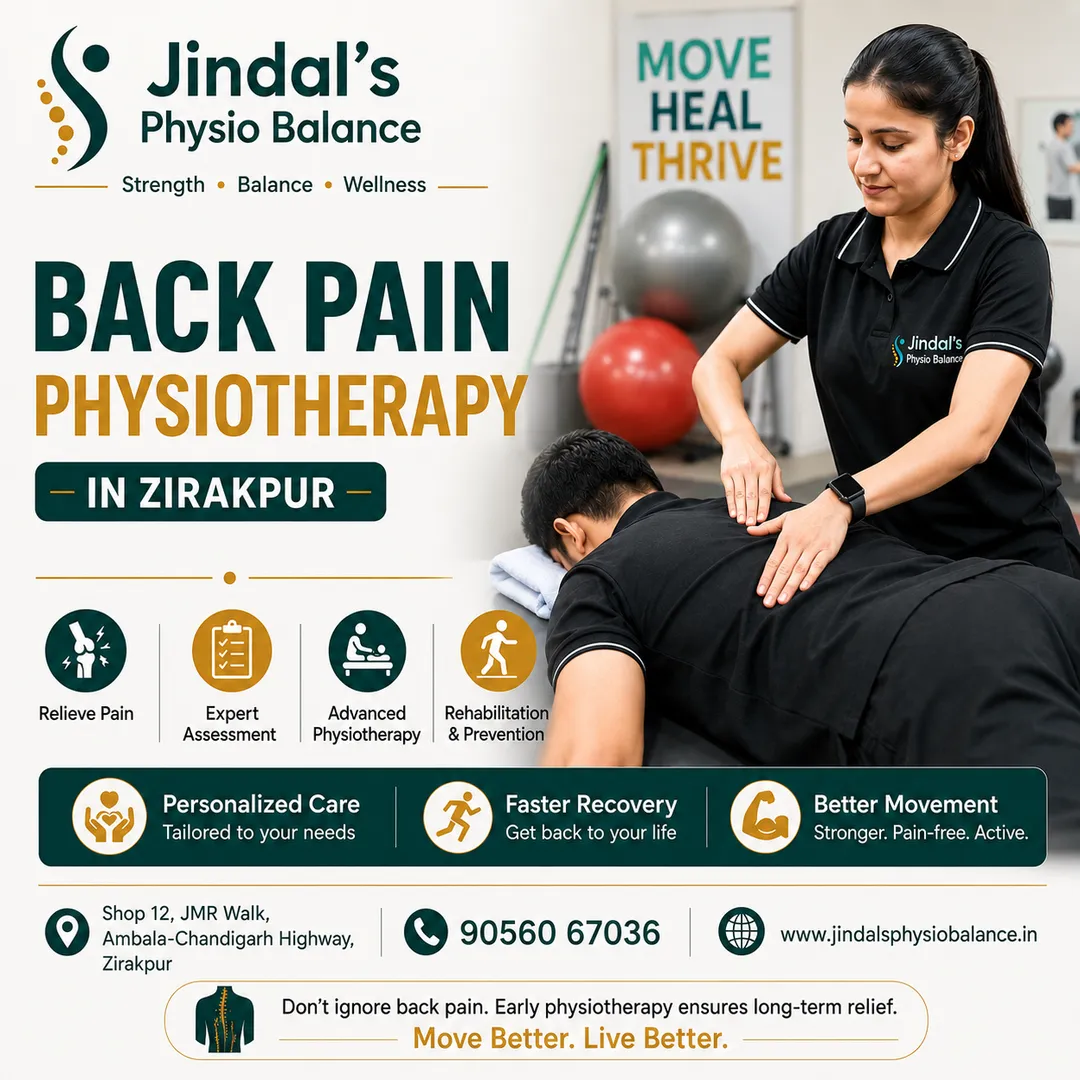
If back pain is affecting your daily life, working ability, walking, exercise or sleep, a proper assessment can help determine the most appropriate rehabilitation approach.
At Jindal’s Physio Balance, Zirakpur, our physiotherapy approach focuses on understanding the individual's symptoms and functional limitations before developing a rehabilitation programme.
Depending on the assessment, rehabilitation may include:
- Back pain physiotherapy
- Lower back rehabilitation
- Sciatica rehabilitation
- Strength training
- Mobility training
- Functional movement rehabilitation
- Post-injury rehabilitation
- Exercise-based physiotherapy
The goal is not simply to reduce pain temporarily but to help you progressively improve movement, strength, physical capacity and confidence.
Frequently Asked Questions
Is physiotherapy good for back pain?
Physiotherapy can be helpful for many people with back pain. Treatment should be individualized according to symptoms, functional limitations and contributing factors.
What exercises are best for lower back pain?
There is no single exercise that is best for everyone with lower back pain. Exercise selection should depend on the individual's symptoms, physical capacity and rehabilitation goals.
Can physiotherapy help sciatica?
Physiotherapy may help some people with sciatica through assessment, education, appropriate exercise and progressive rehabilitation. However, significant or worsening neurological symptoms require medical assessment.
Should I get an MRI for back pain?
An MRI is not automatically required for every episode of back pain. Whether imaging is appropriate depends on the clinical presentation and whether the result is likely to change management. A healthcare professional can advise you based on your symptoms.
Can sitting cause back pain?
Long periods of sitting may contribute to discomfort for some people, but back pain usually cannot be explained by one posture alone. Movement variety, physical capacity, activity levels and other factors may also be relevant.
Where can I get physiotherapy for back pain in Zirakpur?
Jindal’s Physio Balance provides physiotherapy and rehabilitation services in Zirakpur, including back pain and musculoskeletal rehabilitation.
Final Takeaway
Back pain is not one single condition, and there is no universal treatment that works for everyone.
The most appropriate rehabilitation programme depends on the individual's symptoms, physical capacity, movement, functional limitations and goals.
If your back pain is interfering with your daily activities, exercise, work or mobility, consider getting it properly assessed rather than repeatedly treating the pain without understanding the contributing factors.
Jindal’s Physio Balance
Family Physiotherapy & Rehabilitation Centre, Zirakpur
Strength | Balance | Wellness
Keywords