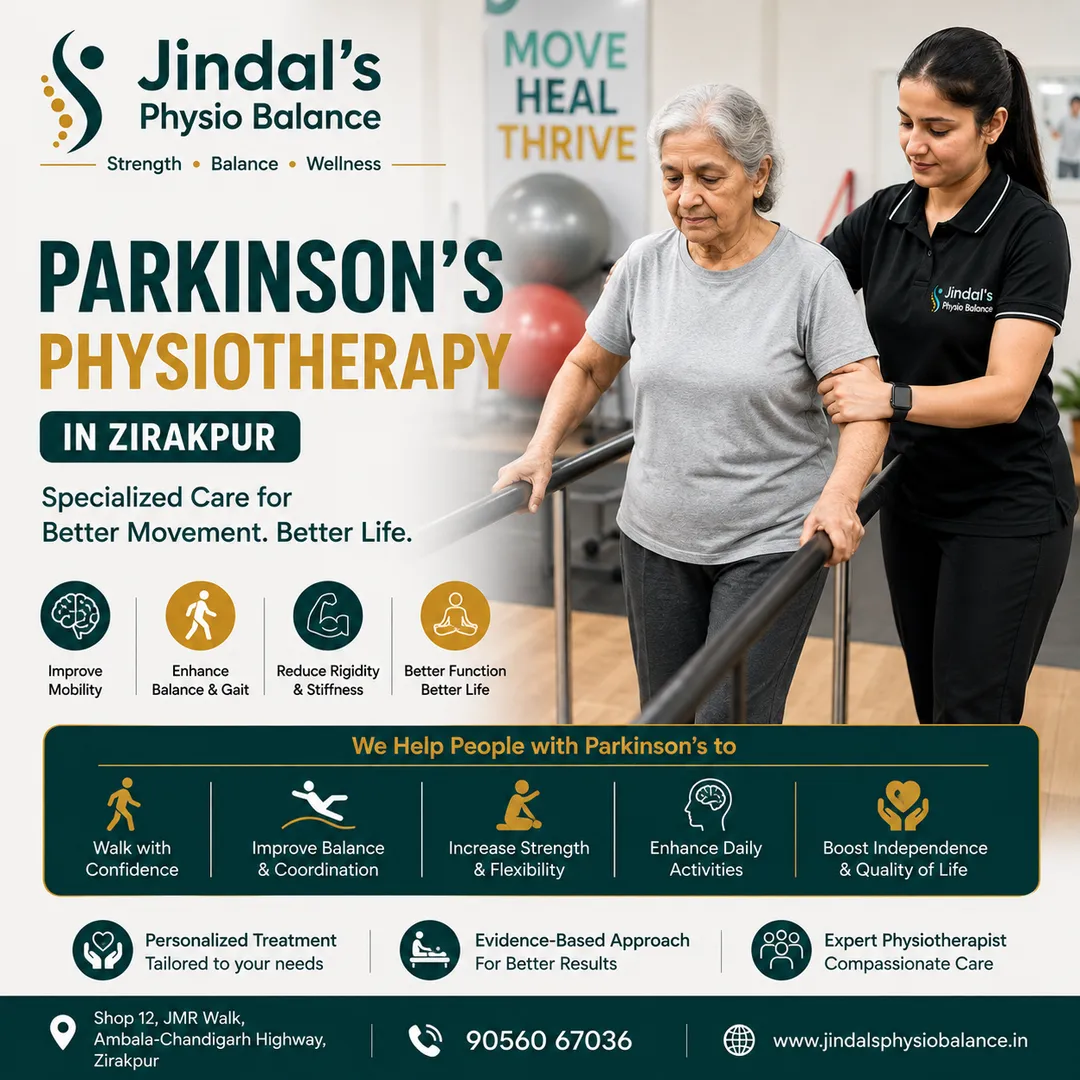
Parkinson’s disease is a progressive neurological condition that can affect movement, balance, walking, posture and the ability to perform everyday activities.
Symptoms can vary considerably from one person to another. Some people may initially notice slowness of movement or stiffness, while others may experience changes in walking, smaller steps, difficulty turning, reduced balance or freezing of gait.
As Parkinson’s disease progresses, these movement difficulties can begin to affect independence and confidence during daily activities.
This is where Parkinson’s physiotherapy and neurological rehabilitation can play an important role.
Physiotherapy does not cure Parkinson’s disease or reverse the underlying neurological condition. Instead, rehabilitation focuses on helping a person maintain or improve movement, physical function, safety and independence for as long as possible.
Current Parkinson’s rehabilitation guidance supports individualized exercise and physiotherapy addressing areas such as aerobic fitness, strength, flexibility, balance, agility, multitasking, walking and functional mobility.
If you are looking for Parkinson’s physiotherapy in Zirakpur, understanding what neurological rehabilitation can actually address is an important first step.
What Is Parkinson’s Disease?
Parkinson’s disease is a neurological disorder that primarily affects movement, although it can also involve several non-motor symptoms.
Common movement-related symptoms may include:
- Slowness of movement
- Muscle rigidity or stiffness
- Tremor
- Changes in walking
- Smaller steps
- Difficulty initiating movement
- Reduced arm swing
- Problems turning
- Balance difficulties
- Freezing of gait
- Changes in posture
Not every person with Parkinson’s experiences all of these symptoms. The severity and combination of symptoms can also change over time. Because of this variation, rehabilitation should be individualized rather than based on a fixed exercise programme.
Why Is Physiotherapy Important in Parkinson’s Disease?
Parkinson’s can gradually affect the way a person moves and performs everyday tasks.
Physiotherapy can help address movement-related problems such as:
- Walking difficulties
- Reduced step length
- Freezing
- Turning difficulties
- Balance problems
- Reduced strength
- Postural changes
- Reduced physical endurance
- Difficulty getting up from a chair
- Difficulty moving in bed
- Difficulty managing stairs
- Fear of falling
The Parkinson’s Foundation notes that physical therapy can help people with Parkinson’s maintain movement and can address walking, freezing, balance, posture, transfers and other functional mobility problems.
NICE recommends Parkinson’s-specific physiotherapy for people experiencing balance problems or motor-function difficulties and recommends considering specialist physiotherapy assessment, education and advice in earlier-stage Parkinson’s disease.
When Should Someone With Parkinson’s See a Physiotherapist?
Physiotherapy does not have to wait until walking becomes severely impaired.
A neurological physiotherapy assessment may be useful when someone has:
- Recently been diagnosed with Parkinson’s disease
- Increasing stiffness
- Slower movements
- Smaller steps
- Difficulty turning
- Freezing episodes
- Balance problems
- Falls or near-falls
- Difficulty getting out of a chair
- Difficulty getting in or out of bed
- Reduced walking endurance
- Reduced confidence while walking
- Increasing dependence on family members
Early assessment can also establish a functional baseline and help identify areas that may benefit from intervention.
The Parkinson’s Foundation's current rehabilitation pathway emphasizes proactive rehabilitation and individualized exercise planning after diagnosis.
What Does a Parkinson’s Physiotherapy Assessment Include?
Parkinson’s rehabilitation should begin with a detailed assessment.
Depending on the individual's presentation, a neurological physiotherapist may assess:
1. Walking
Walking assessment may look at:
- Step length
- Walking speed
- Cadence
- Arm swing
- Foot clearance
- Turning
- Starting and stopping
- Changes in walking direction
2. Freezing of gait
Freezing can make a person feel as though their feet are temporarily “stuck to the floor.”
It may occur particularly during:
- Turning
- Walking through narrow spaces
- Starting to walk
- Approaching a doorway
- Changing direction
- Performing another task while walking
Identifying when freezing occurs can help determine appropriate strategies and safety modifications.
3. Balance
Balance assessment is particularly important because postural instability can increase fall risk in Parkinson’s disease.
Assessment may include static balance, dynamic balance, turning and functional activities.
4. Functional mobility
The physiotherapist may assess tasks such as:
- Sit-to-stand
- Bed mobility
- Transfers
- Stairs
- Walking indoors
- Walking outdoors
5. Strength
Muscle strength may be assessed to identify limitations affecting walking and daily function.
6. Posture
Changes in posture can affect movement efficiency and balance.
7. Dual-task performance
Some people with Parkinson’s experience increased difficulty when walking while simultaneously performing another motor or cognitive task.
For example:
Walking + talking
Walking + carrying an object
Walking + counting
Balance + reaching
Multitasking is specifically included in current Parkinson’s exercise recommendations.
Parkinson’s Gait Training
Walking rehabilitation is one of the important areas of Parkinson’s physiotherapy.
A physiotherapist may work on:
- Step length
- Walking speed
- Foot clearance
- Turning
- Starting movement
- Stopping safely
- Direction changes
- Obstacle negotiation
- Arm swing
- Rhythmic movement
- Walking confidence
External cueing strategies may also be incorporated when appropriate.
Cueing can involve visual, auditory or other external signals designed to help facilitate movement.
The specific strategy should be selected according to the individual's presentation.
Physiotherapy for Freezing of Gait
Freezing of gait can be particularly frustrating and can increase fall risk.
A person may experience freezing when:
- Initiating walking
- Turning
- Approaching a doorway
- Walking in crowded spaces
- Changing direction
- Performing another task while walking
Physiotherapy may include identifying triggers, practicing movement strategies, using appropriate external cues and improving safety during functional activities.
The aim is not simply to tell someone to “walk faster.”
The strategy should be individualized.
Balance Training for Parkinson’s Disease
Balance problems can become increasingly important as Parkinson’s progresses.
Balance rehabilitation may include:
- Weight shifting
- Reaching activities
- Stepping strategies
- Direction changes
- Turning practice
- Functional balance
- Obstacle negotiation
- Dynamic balance
- Perturbation-based activities when appropriate
- Dual-task training
Safety is particularly important.
The Parkinson’s Foundation identifies balance, agility and multitasking as one of the four major domains of its current Parkinson’s exercise recommendations.
Strength Training in Parkinson’s Disease
Reduced physical activity and movement limitations can contribute to reduced strength and physical capacity.
Depending on the person's ability and medical status, strengthening may target:
- Lower limbs
- Upper limbs
- Trunk
- Hip musculature
- Functional movement patterns
Strength training should be progressively adapted rather than using the same resistance and repetitions for every patient.
Current Parkinson’s exercise recommendations include strengthening as one of the major exercise domains.
Exercise for Parkinson’s Disease
Exercise is an important component of Parkinson’s management.
Current recommendations emphasize four broad areas:
Aerobic activity
Activities may include appropriately selected walking, cycling, swimming, dancing or other rhythmic aerobic activities.
Strength training
Resistance exercises can target major muscle groups and can be progressively modified according to ability.
Flexibility
Stretching and active mobility can help address stiffness and maintain movement.
Balance, agility and multitasking
These activities can address dynamic balance, directional changes, stepping, agility and the ability to perform movement while handling another task.
The 2026 Parkinson’s Foundation/ACSM update emphasizes that exercise programmes should be tailored to the person's ability, medication status and stage of disease.
Parkinson’s Physiotherapy During “ON” and “OFF” Periods
Some people with Parkinson’s experience fluctuations in movement associated with medication timing.
A person's mobility may therefore vary throughout the day.
This is important during rehabilitation.
The physiotherapist should understand the person's medication schedule and how movement changes throughout the day when planning assessment and exercise.
Current Parkinson’s exercise recommendations specifically advise considering medication status and recommend exercise sessions during ON medication periods when appropriate for safety and benefit.
Patients should follow their prescribing clinician's medication instructions and should not change medication timing independently for exercise.
Can Physiotherapy Cure Parkinson’s Disease?
No.
Parkinson’s disease is a progressive neurological condition, and physiotherapy does not cure the disease or remove its underlying cause.
The purpose of physiotherapy is different.
Rehabilitation aims to help the person:
- Maintain mobility
- Improve physical capacity
- Improve walking
- Improve balance
- Reduce functional limitations
- Improve safety
- Maintain independence
- Adapt to changing symptoms
This distinction is important because Parkinson’s rehabilitation should focus on realistic functional goals rather than promising a cure.
Physiotherapy for Advanced Parkinson’s Disease
People with more advanced Parkinson’s may experience greater difficulty with:
- Walking
- Transfers
- Balance
- Falls
- Bed mobility
- Stairs
- Postural control
- Fatigue
- Functional independence
At this stage, rehabilitation may need greater emphasis on safety, caregiver education, appropriate assistance and maintaining functional abilities.
The goal may shift from improving performance to maintaining abilities, preventing avoidable complications and supporting quality of life.
Home Exercise and Caregiver Involvement
Family members and caregivers can play an important role in supporting safe movement.
A physiotherapist may teach caregivers:
- Safe transfer techniques
- Appropriate assistance during walking
- Fall-prevention strategies
- Home exercise routines
- Environmental modifications
- Strategies for difficult functional activities
However, caregivers should avoid physically pulling or forcing a person through movement unless specifically trained to assist with that activity.
When Should a Person With Parkinson’s Be Referred for Further Medical Evaluation?
Physiotherapy is one component of Parkinson’s management.
Medical follow-up remains important, particularly when there are significant changes in symptoms.
Further evaluation may be appropriate if there is:
- Rapid deterioration in mobility
- Repeated unexplained falls
- New neurological symptoms
- Significant swallowing problems
- Major changes in cognition
- Severe dizziness or fainting
- Sudden weakness
- Significant changes in bladder or bowel function
- New or rapidly worsening symptoms
Parkinson’s care often involves a multidisciplinary team, which may include neurologists, physiotherapists, occupational therapists, speech and language therapists and other healthcare professionals.
Parkinson’s Physiotherapy in Zirakpur
If Parkinson’s disease is affecting walking, balance, transfers, posture or independence, neurological physiotherapy can help identify movement problems and develop an individualized rehabilitation programme.
At Jindal’s Physio Balance, Zirakpur, neurological rehabilitation can focus on areas such as:
- Parkinson’s rehabilitation
- Gait training
- Balance and postural control
- Strengthening
- Mobility training
- Functional movement
- Transfer training
- Freezing strategies
- Dual-task training
- Caregiver education
- Fall-risk management
The programme is adapted according to the person's current abilities, symptoms, goals and stage of rehabilitation.
Our goal is not to promise a cure.
It is to help the person move as safely, independently and confidently as possible.
Frequently Asked Questions
Can physiotherapy help Parkinson’s disease?
Physiotherapy can help address movement-related problems associated with Parkinson’s, including walking difficulties, balance problems, reduced mobility, strength limitations and functional mobility.
Is exercise safe for people with Parkinson’s?
Exercise can be beneficial, but the programme should be adapted to the person's abilities, disease stage, medication status, medical conditions and safety needs.
Can physiotherapy stop Parkinson’s from progressing?
Physiotherapy does not cure Parkinson’s disease or stop its underlying progression. Rehabilitation focuses on maintaining and improving mobility, function, safety and independence.
Can physiotherapy help freezing of gait?
A physiotherapist can assess freezing triggers and teach individualized movement and cueing strategies that may help with walking initiation and other challenging situations.
Can physiotherapy help prevent falls in Parkinson’s?
Balance, gait and functional training can be incorporated into rehabilitation to address fall risk. Home and environmental safety should also be considered.
When should Parkinson’s physiotherapy start?
Physiotherapy does not necessarily need to wait until severe movement problems develop. Current guidance supports considering specialist physiotherapy assessment earlier in the disease course and Parkinson’s-specific physiotherapy when motor or balance problems are present.
Where can I get Parkinson’s physiotherapy in Zirakpur?
Jindal’s Physio Balance provides neurological physiotherapy and rehabilitation in Zirakpur, including gait, balance, mobility and functional rehabilitation for people with Parkinson’s disease.
Final Takeaway
Parkinson’s disease affects people differently, so rehabilitation should never be a one-size-fits-all programme.
A neurological physiotherapy assessment can identify difficulties with walking, balance, posture, strength, transfers, freezing and functional mobility.
With an individualized programme and appropriate medical care, rehabilitation can help a person remain active, safe and as independent as possible.
Jindal’s Physio Balance
Family Physiotherapy & Rehabilitation Centre, Zirakpur
Strength | Balance | Wellness
Keywords